Investigating hidden flaws and detecting and monitoring visible and sub-surface faults in large structures
Estimated reading time 2 minutes
Join the webinar on 16 December 2025 2.30pm, to hear how NPL has applied practical solutions for detecting defects in materials and civil engineering structures to ensure critical components remain safe throughout their lifecycle.
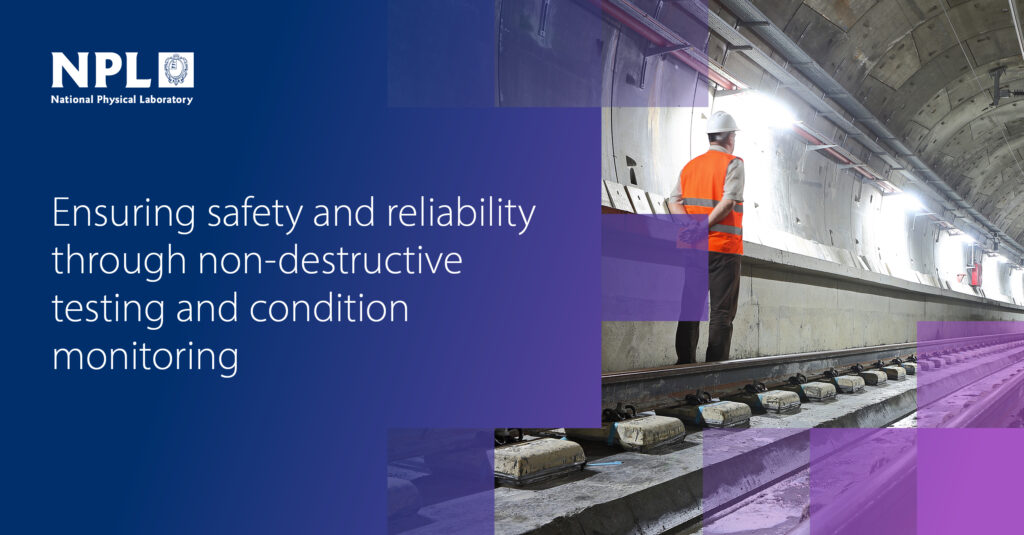
Jon Hughes introduces two of NPL’s flagship structural monitoring projects: Network Rail’s DIFCAM inspection trolley, which represents a step-change in the way Network Rail inspects railway tunnels, and Sellafield’s HAIS, which carries out long-term structural monitoring deep inside nuclear waste stores. Find out how NPL have overcome technological challenges including difficult and remote access and how to interpret multi-terabyte datasets.
Non-destructive testing (NDT) encompasses a wide range of analytical techniques that enable the identification of damage and irregularities in the materials of safety-critical components without the need for destructive sectioning. It allows the detection of manufacturing and in-service defects that could compromise structural integrity, reduce service lifetimes and increase the likelihood of failures. NDT can be used across a variety of settings – from on-line production quality control through to operational inspection and lifetime management – in sectors such as rail networks, nuclear, automotive, aerospace, marine and many other engineering applications.
NPL provides a range of non-destructive testing techniques catering for a wide array of testing applications. From material assessment to component testing, these methods can be used to improve production quality, optimising the manufacturing process. They can be used to detect defects that could cause failure and provide insights into new materials to accelerate technology adoption.
As part of our condition monitoring capability, NPL is able to detect and monitor visible and sub-surface faults in large structures such as bridges, tunnels and buildings. Changes in the structure over time can be quantified by using techniques such as digital image correlation (DIC) on a massive scale. This can significantly reduce inspection times and improves confidence in inspection results. It can be carried out remotely, which removes workers from dangerous environments.