ROEMHELD INTRODUCES FIRST-EVER FLOATING ZERO-POINT WORKHOLDING SYSTEM
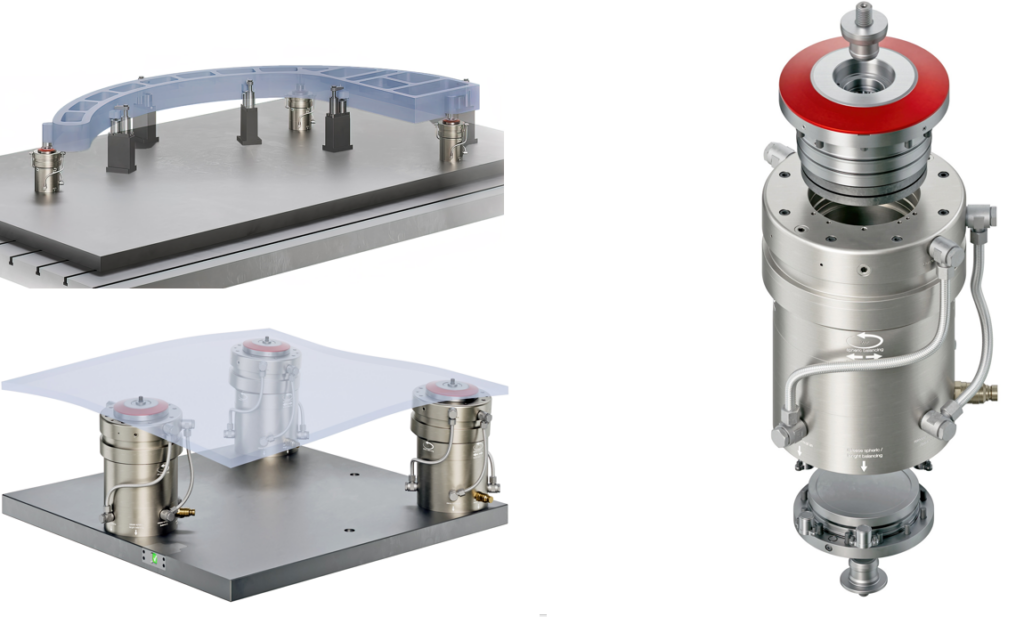
A new range of heavy-duty workholding pedestals has been introduced by Roemheld (www.roemheld.co.uk) that it claims is the first automatically adjusting zero-point clamping system on the market. The units feature integral Z-axis height compensation of ±2.5 mm, as well as positional adjustment of ±1.5 mm in a single lateral axis, or in both X and Y, according to the variant selected. Additionally, the pad on the top of the clamp pedestal pivots by ±5.0 degrees in one direction, or in any direction, so that it fits flush against a curved or distorted surface.
STARK.spheric is manufactured by Stark Spannsysteme, part of the German Roemheld group. The clamping system is targeted at sectors such as aerospace, power generation and heavy equipment manufacturing, where structural components like wing spars, fuselage sections, bulkheads and large frames undergo intensive milling. It likewise simplifies the processing of large fabrications in the shipbuilding and rail sectors, for example, where welding distortion makes clamping on standard zero-point grids nearly impossible.
When machining aerospace parts, where up to 90% or even more of the stock material is milled away during roughing, internal residual stresses in the billet, casting or forging are invariably released. Conventional rigid clamping arrangements fight against this physical change, causing a workpiece to warp when unclamped after a subsequent finishing operation.
In contrast, STARK.spheric pedestals adapt dynamically to the workpiece’s natural shape in all three dimensions before it is first clamped. As a workpiece is lowered onto a set of pedestals, each adjusts passively and automatically to the workpiece’s actual geometry by self-adjusting up to the linear and angular limits quoted above.
After roughing is complete, the clamping force is released by a G-code in the machining cycle to allow the workpiece material to settle into its natural, stress-free state, whereupon it is reclamped for finishing after the pedestals have repositioned themselves laterally and in terms of angular tilt. The Z distance remains constant, however, so the height reference stays valid for the finishing passes.
To facilitate automated machining, even if only one operation is involved and release and reclamping are not required to relieve stress, the 3D floating interface automatically accommodates part-to-part tolerance discrepancies, enabling reliable robotic component loading. An added benefit is that the raised profile of STARK.spheric workholding provides generous tool clearance, allowing cutters deployed by 4-axis and 5-axis machining centres unrestricted access to the sides of a workpiece.
In practical scenarios, STARK.spheric can be set up in multi-unit support configurations, such as a classic three-point fixture layout. In this arrangement, a primary zero-point element establishes the absolute spatial location while accommodating angular variations, while secondary units compensate for directional expansion. Unlike a simple riser block, a STARK.spheric unit is a solid, heavy-wall, steel assembly weighing about 28 kg. It acts as both a vibration-free load-bearing pillar and as a hydraulic actuator for clamping.
Heavy-duty spring packs in the pedestal generate high mechanical retention forces, which are released hydro-pneumatically at the end of a machining cycle. The unit can be fixed directly to a machine table or via a stud that locates into a Stark receiver plate. Workpiece clamping normally uses the manufacturer’s zero-point chuck on the top of each pedestal that engages threaded studs previously attached to the underside of the component to be machined, or its fixture.
Alternatively, if the component itself must be secured but cannot be pre-drilled, it may be held by swing clamps on sacrificial lugs that are milled away at a later stage. As the part rests on top of the pedestals, the supporting pads automatically pivot and align to the underside without pushing, lifting or warping it. In that case, the STARK.spheric pedestals act purely as self-aligning, lockable supports, rather than active pull-down zero-point chucks as well.